

OpusPlan in Claude Code — A Mode That Saves Both Time and Tokens
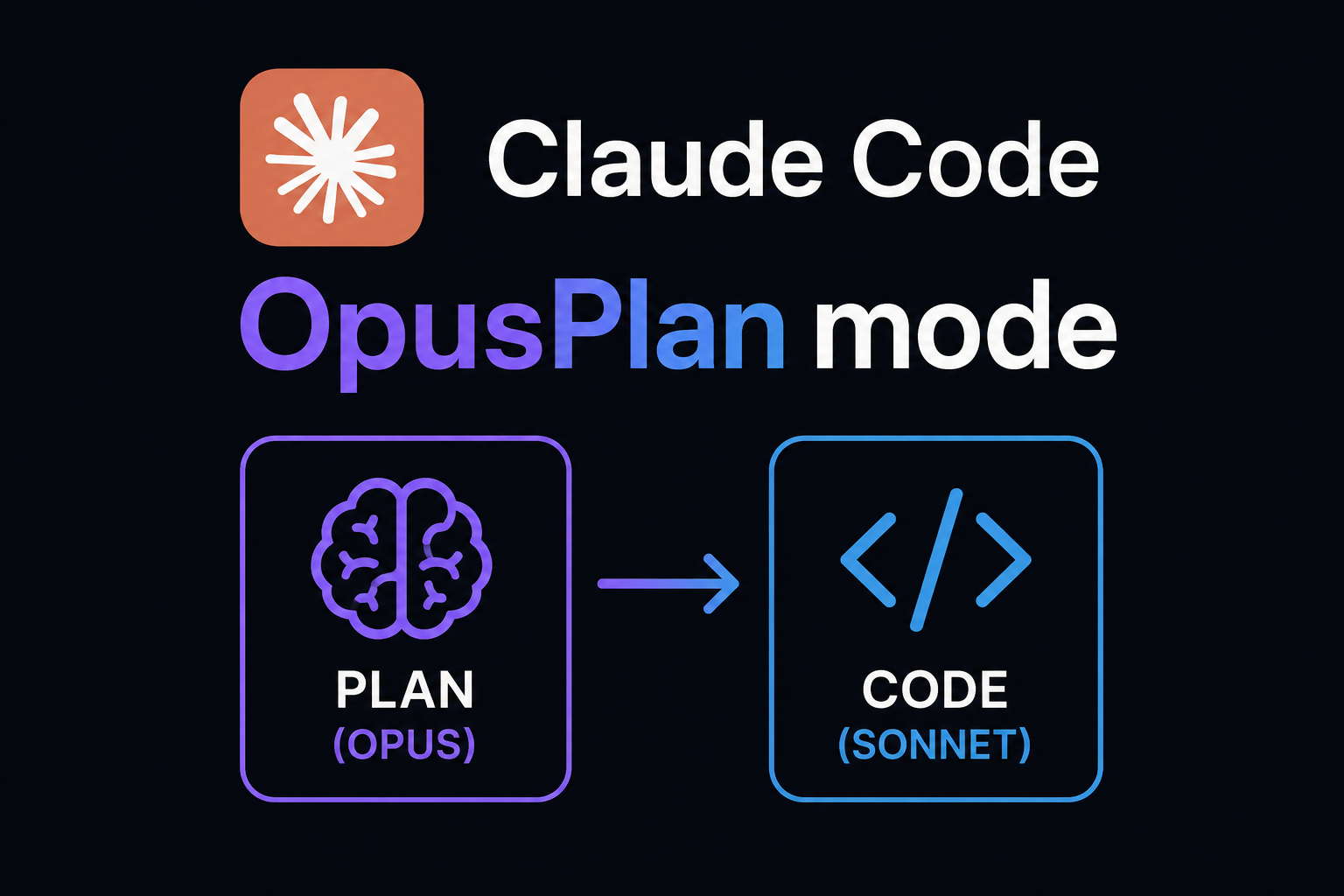
Lately, I've been using OpusPlan quite a lot in Claude Code. In my opinion, it's one of the most convenient features when working with an agent on larger tasks.
The idea is simple: Opus is used for planning, while Sonnet handles the implementation once the plan is ready. And the switch between the two happens automatically.
I think this is a very logical approach.
Why is it useful?
Before discovering OpusPlan, I often ran into a situation like this:
- I switch to Opus.
- I ask the agent to create a plan.
- The agent finishes the planning and immediately offers to start implementing it.
- At that point, I want to switch to Sonnet, but doing so is rather inconvenient.
I have to press Esc, leave the planning mode, manually switch the model, and then ask Claude to continue with the already prepared plan.
With OpusPlan, none of this is necessary.
First, Opus works on the difficult part — analyzing the task, thinking through the architecture, and breaking the work into steps.
Then Claude automatically switches to Sonnet and starts implementing the plan.
Saving tokens
For me, another major advantage is the potential cost savings.
- Opus is used where a more capable model is actually valuable — analysis, architecture, and planning.
- Sonnet handles most of the routine implementation, which is significantly cheaper.
So the workload is distributed quite naturally: the more expensive model handles the difficult decisions, while the cheaper one does most of the actual implementation.
How to enable OpusPlan
There is one small catch.
If you open the model selector with:
/model
you won't find OpusPlan there.
You need to activate it manually:
/model opusplan
After that, OpusPlan will appear in the model list and can be selected like the other models.
Final thoughts
For now, OpusPlan has become almost my default mode for larger tasks in Claude Code.
It eliminates unnecessary model switching, makes the workflow much smoother, and allows me to use expensive Opus tokens only where they provide the most value.
For me, that's probably the biggest advantage: Opus does the thinking, Sonnet does the work.